

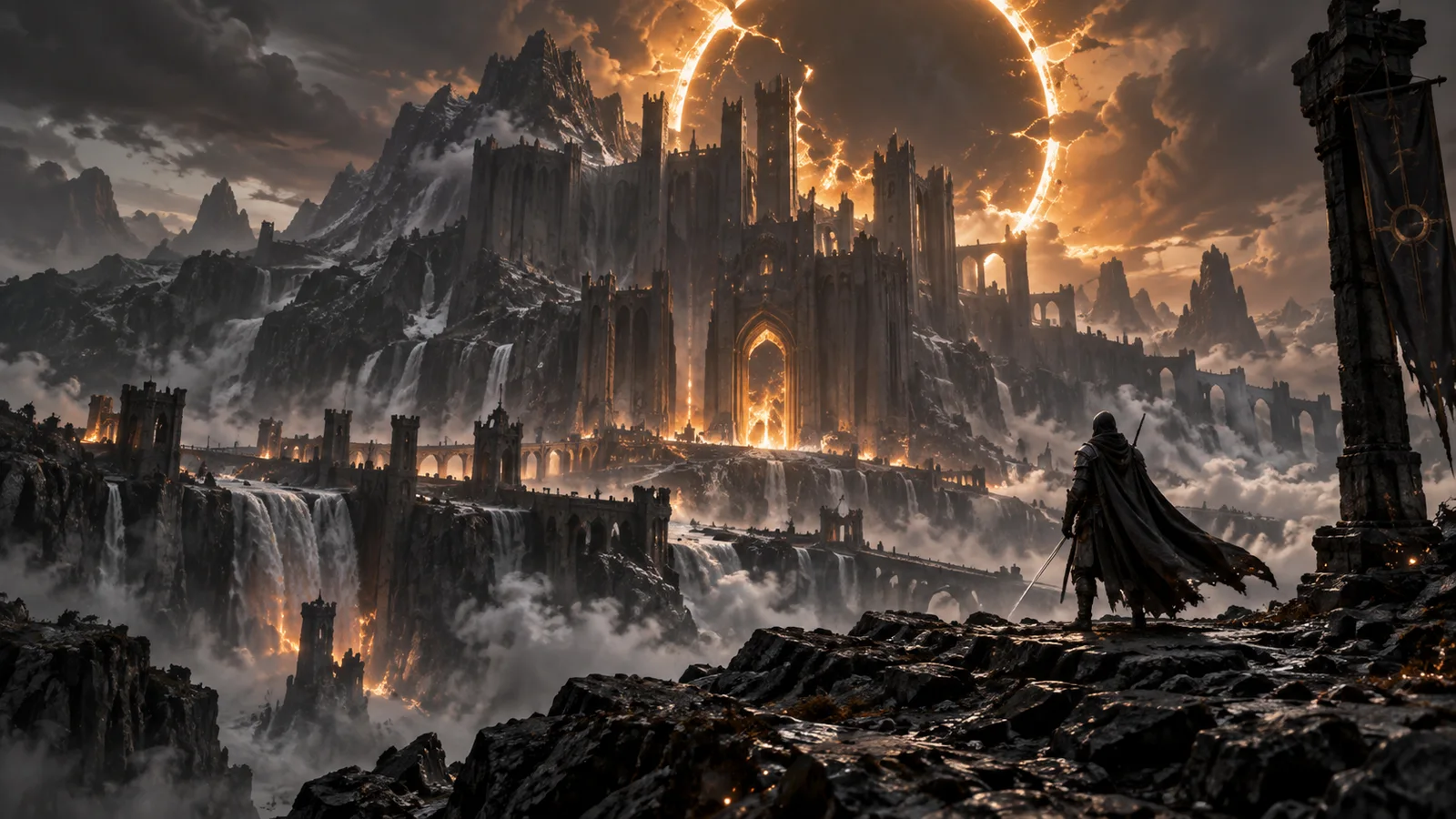
An ambitious RPG begins with a fantasy the player wants to inhabit. They might become a wandering knight, a resourceful explorer, a leader of companions, or a builder of alliances. Online play adds another promise: that these experiences become more meaningful when shared with other people. Both promises are attractive. Neither is a complete specification. Role-playing game development becomes manageable when the team translates that imagined experience into decisions about interaction, progression, content and the structure of the world.
This guide explores how to plan an action RPG, cooperative adventure or online role-playing game for PC and mobile. It focuses on the questions that affect scope and quality before a large content pipeline begins. The examples are hypothetical design exercises, not descriptions of shipped Darkbeast Games products. Technical references are provided where they help explain foundational choices; the production recommendations are our editorial analysis. Use them to prepare a better project brief and to discuss tradeoffs with a development partner.
Define the role before the feature list
A role is more than a character class. It describes the decisions players make and the identity those decisions create. A ranger who reads the landscape should interact differently from a knight who controls space through close combat. A diplomat should need more than a different dialogue portrait. If all roles ultimately use the same actions with different numbers, the game may offer less expressive variety than its character selection screen suggests.
Write a short description of the player’s ordinary session. Include where the session begins, what motivates the player to leave safety, the kind of obstacle they face, and what changes when they return. This exercise exposes missing connections between systems. Combat, crafting and dialogue can each look interesting in isolation while failing to support a satisfying loop together. A coherent RPG lets each system reinforce the fantasy instead of competing for attention merely because the genre often includes it.
Choose the shape of the world
Open world, connected regions, hub and spoke, and mission-based structures are useful design options. They create different expectations about freedom, pacing and repeat visits. A large map can support discovery, but it also requires navigation, meaningful landmarks, content distribution and reliable traversal. A smaller sequence of regions can deliver a strong sense of journey while concentrating production effort. Size alone does not determine whether a world feels convincing.
Draw the player’s routes before drawing the final geography. Mark where they learn a system, where they can test mastery, and where they encounter a new decision. Consider what happens if they explore in an unexpected order. A world can be visually open while progression remains tightly controlled, but the restrictions should make sense to the player. Discuss gates, shortcuts and return paths early, since these affect level design, narrative dependencies and the amount of content required to sustain curiosity.
Prototype the core combat relationship
Combat quality comes from the relationship between intention, action and feedback. Players need to read a situation, choose a response, understand what happened and decide what to do next. Begin with a small number of clearly differentiated actions. A basic attack, a defensive option, a movement ability and two enemy behaviours can reveal more than a long list of unfinished skills. Timing, camera behaviour and readable effects deserve attention before expensive animation variety.
Test combat in representative spaces. A system that works in an empty arena may fail in a narrow corridor or near a wall. Include targets at different elevations if the game needs verticality. Observe whether players can distinguish danger from spectacle. On mobile, check what their hands obscure and how accurately they can aim. On PC, test the intended input methods. The objective is a combat language that remains understandable when pressure increases, not a collection of impressive moves shown separately.
Build progression around decisions
Progression should change how players think, not only increase the size of displayed numbers. A new ability might create a different approach to an encounter. A piece of equipment might improve one strength while introducing a meaningful constraint. A companion might open new combinations. Even a simple system can feel rich when upgrades produce visible changes in play. A complicated skill tree can feel empty when its choices are difficult to notice.
Map a small progression arc from beginning to end. Show what players know, what they can do, and what questions they are asking at each stage. Then identify the content needed to teach and test those changes. Avoid introducing several mechanics at once unless the audience and interface can support that density. Balance work becomes easier when designers can explain why an upgrade exists. If a reward has no clear role beyond filling a milestone, reconsider whether it deserves production and maintenance effort.
Design quests as playable situations
A quest is strongest when the player understands what matters and can act on that understanding. Start with a situation, an obstacle and a consequence. The situation might involve a settlement losing access to a resource. The obstacle could require exploration, negotiation or combat. The consequence should be legible in the world or in the people affected. This structure is more useful than beginning with a required number of dialogue lines.
Branching quests add value when the branches express meaningful differences. They also create writing, implementation, localisation and testing work. Track which decisions persist and how later content reads them. A modest number of well-supported consequences can feel more responsive than many superficial choices. Build one complete quest with its interface, rewards, save behaviour and failure handling before estimating dozens more. That reveals the actual content pipeline and exposes hidden production tasks that a written quest outline cannot show.
Decide what online really means
An online RPG could mean cooperative missions, a shared social hub, player trading, competitive encounters or a persistent world. These features do not arrive as one package. Each creates its own design obligations. A cooperative mission needs joining, leaving and reward rules. Trading introduces questions about ownership and abuse. A persistent world needs continuity across sessions and an operational plan. Be precise about which social experience is essential to the player promise.
Epic’s networking overview distinguishes local play from networked play and explains client-server state replication. The practical implication for a project brief is to discuss networking while designing the core systems. A game built around one machine controlling everything can require substantial revision when other players arrive. Ask for an early multiplayer proof with the intended player count and representative interactions, rather than treating a late connection between two editor windows as sufficient validation.
Keep important shared state trustworthy
Players need to believe that rewards, progression and competition follow understandable rules. Decide which system is responsible for authoritative outcomes and which information is only visual presentation. Valuable shared state deserves particular attention: inventory, trade results, currency and completed objectives should behave consistently when requests are repeated or connections fail. The exact architecture depends on the game, but responsibility should be explicit.
Discuss failure scenarios with concrete examples. What happens when a player disconnects as a boss reward is granted? What if a purchase response arrives twice? What if a party leader leaves during a mission transition? These are ordinary product questions, not rare edge cases to ignore until release. Define the desired player experience, then ask the technical team to demonstrate it. Support tools should make it possible to investigate a disputed outcome without requiring someone to guess from a screenshot or manually rewrite live data.
Make cooperation worth the effort
Adding another player does not automatically create cooperation. Design reasons to notice and respond to one another. Complementary abilities, shared environmental interactions and readable opportunities for assistance can make a group feel coordinated. Avoid requiring constant voice communication unless that is appropriate for the audience. Pings, clear objectives and understandable visual signals can support groups whose members do not share a language or a microphone.
Consider the difference between friends and strangers. Friends may tolerate experimentation, waiting and uneven skill levels. Matchmade groups need stronger guidance and clearer expectations. Decide how the game handles late arrivals, inactive players and uneven progression. A generous catch-up mechanism may support social play better than strict numerical equality. Test whether the least experienced participant still feels useful. A cooperative RPG succeeds when the group experience creates memorable moments without turning one player into a permanent passenger.
Build an economy that supports the game
An RPG economy includes every source and use of value: equipment, materials, experience, currencies, time and access. Start with a small set of resources and clear reasons to earn and spend them. Map what enters the economy, what leaves it, and what accumulates. A resource that has no meaningful use becomes clutter. A resource that blocks every interesting action can make the game feel restrictive instead of rewarding.
Use a simple model to explore progression before implementing a large catalogue. Test how different play styles affect resource flow. Consider players who repeat efficient content, skip optional activities or return after a long break. If the game includes trading, evaluate how value moves between accounts. Avoid assuming that numerical balance alone creates a healthy economy. Clarity, fairness and player agency matter. Any monetisation model should be understandable and consistent with the experience promised to the audience.
Keep content tools close to designers
RPGs often need substantial content: encounters, items, dialogue, rewards, environments and events. The cost of creating the next piece depends heavily on the tools and conventions established for the first pieces. Give designers structured ways to tune values and assemble common patterns. Validate content automatically where possible, especially references, missing rewards and impossible quest states. A clear error at authoring time is cheaper than a confusing player report later.
Document the boundaries of reusable systems. A quest template should accelerate appropriate content without forcing every story into the same shape. An enemy framework should support meaningful variation without requiring bespoke code for each creature. Review how long a complete content unit takes to design, implement, test and revise. That measured cycle is a stronger basis for scheduling than counting proposed quests or monsters. Production becomes more predictable when the team understands the real cost of a finished, integrated unit.
Translate the RPG experience to mobile
A mobile RPG needs an interface built for the way people hold and use a phone. Keep important decisions visible without making every control permanently occupy the screen. Separate frequent combat actions from occasional inventory management. Use readable text and clear touch targets. Consider the cost of a mistaken tap, especially where an action spends valuable resources or commits a player to a long activity.
Prototype a complete mobile session on a real device. Include the loading flow, combat, rewards, equipment change and interruption recovery. A landscape screenshot cannot tell you whether the interface is comfortable to use. Test longer sessions for readability and performance, and decide how the game responds to backgrounding. If the PC and mobile versions share an account, explain which progression carries over and which interactions differ. Cross-platform ambition should preserve player understanding, rather than merely reproducing the same menu layout everywhere.
Test latency as part of game feel
A responsive local prototype can behave differently when players communicate over a network. Create tests that include delay, inconsistent delivery and disconnection. Observe the player experience as well as the technical logs. Does an attack appear to connect but produce no understandable result? Do remote characters move in distracting ways? Does an interaction fail silently? The answers should influence ability design and feedback as well as networking implementation.
Different genres tolerate different forms of delay. A turn-based encounter, a cooperative exploration game and a precise competitive action system have different requirements. Avoid borrowing a networking target without considering the intended experience. Define acceptable behaviour for the actions that matter most. Then test those actions under realistic conditions with representative player counts. Keep the test repeatable, so a later content or systems change can be checked against the same expectations instead of relying on memory and subjective impressions.
Plan moderation and player support
Social features create human interactions as well as technical requirements. Decide how players can report problems, block unwanted contact and understand community expectations. A text chat, public profile and trading system need different controls. Consider whether a feature is necessary for the first release and whether the studio can support it responsibly. A smaller social surface that works well can be more valuable than a large one with unclear ownership.
Support staff need information that helps resolve issues without exposing unnecessary personal data. Record the events required to investigate progression failures or repeated disruptions, and define who can access those records. Establish escalation paths for urgent problems. Explain downtime and known issues clearly. These choices should reflect the scale and audience of the game. Even a small cooperative title benefits from knowing who responds when players cannot join their friends or believe a hard-earned reward has disappeared.
Scope an RPG vertical slice
A useful vertical slice demonstrates the game’s central promise at representative quality. For a cooperative dark fantasy RPG, it might include a small hub, a complete quest, a short exploration route, two complementary roles and one memorable encounter. Integrate the reward, save and return journey. Include enough finished art and audio to judge the intended atmosphere. Avoid building a cinematic introduction that demonstrates almost none of the ordinary game.
Use the slice to answer specific questions. Is combat readable? Does cooperation improve the experience? Can the team produce content at the required pace? Does the target device handle the visual direction? What happens when a player leaves? Record what the slice proves and what it does not. A single polished environment cannot establish the cost of an entire open world. It can, however, provide credible evidence for the next production decision and reveal which ambitions need adjustment.
Measure the experience beyond retention
Returning players can be a useful signal, but a single metric cannot explain whether an RPG is working. Combine behavioural information with observation and player conversations. Look at whether players understand their objectives, use the intended systems, complete meaningful choices and recover from setbacks. Identify where the experience becomes confusing or repetitive. A long session could indicate engagement, but it could also indicate difficulty finding an exit or resolving an unclear task.
Choose questions before choosing dashboards. If players avoid a crafting system, investigate whether it is unnecessary, poorly explained or inconvenient. If a quest has a high abandonment rate, inspect the encounter, instructions and reward together. Compare different groups carefully rather than assuming every player wants the same pace. Use findings to strengthen the game’s intended identity. Chasing every visible metric at once can pull an RPG away from the coherent fantasy that originally made it compelling.
Prepare a brief that starts a productive conversation
Describe the RPG you want to make in terms of player identity, core actions, world structure and social experience. Include target platforms, expected session length, art references and the project’s current stage. State which features are essential and which remain open. If multiplayer matters, specify whether you mean cooperative missions, shared hubs, competitive play or a persistent world. Include your available budget range and the next milestone you want to reach.
The most useful enquiry explains both ambition and uncertainty. You might have a strong world and need help finding its core loop. You might have a prototype and need a production plan. You might have an existing game and need a carefully scoped mobile adaptation. Those are different starting points, and each deserves a different proposal. Tell the studio what evidence you already have, what players should feel, and what you need to learn next. That is how a large imagined world becomes a practical development conversation.
Explore our game portfolio or send a project enquiry.